
Tracing your immigrant ancestors reveals a story of courage, adaptation, and identity that connects your family to the broader currents of world history. Each migration, from early European settlers to 20th-century arrivals from across the globe, left traces in ship manifests, naturalization files, and community records. Behind these documents are the human stories of those who chose to leave, to begin again, and to shape a new life.

Trace a legacy that spans continents, generations, and homes.
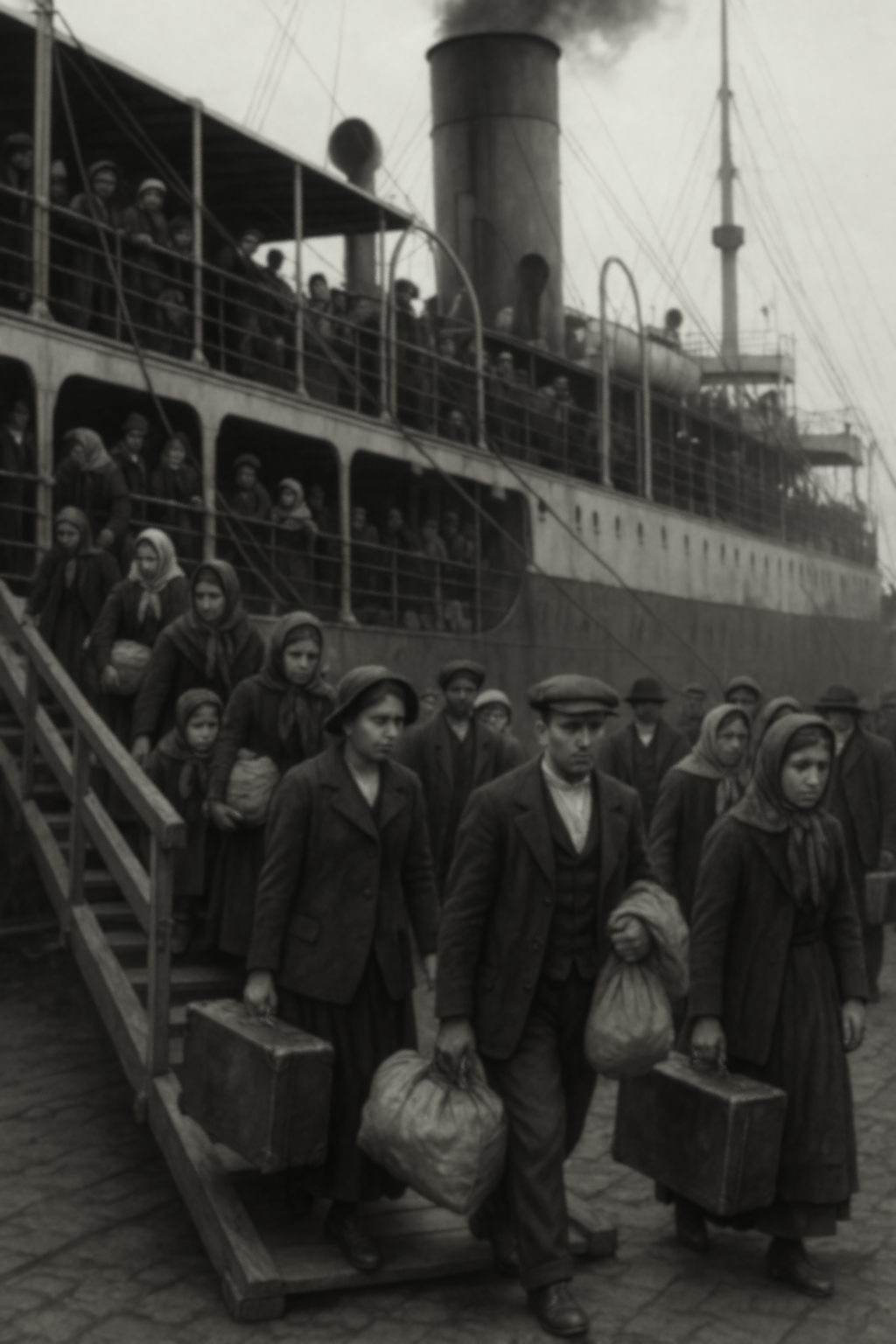
From the colonial era through the twentieth century, the United States was shaped by successive waves of immigration, each leaving a distinct imprint on the nation’s cultural and social fabric.
In the 1600s and 1700s, English, Scottish, Irish, and German settlers crossed the Atlantic in search of land, faith, and freedom. By the mid-19th century, millions more arrived: Irish families fleeing famine, Germans seeking stability after political unrest, and Scandinavians drawn by opportunity in America’s expanding frontier.
The turn of the 20th century ushered in even greater diversity. Italians and Eastern Europeans, including Poles, Slovaks, and Jews, came seeking safety and work. Chinese, Japanese, and Filipino immigrants built vibrant communities in the West despite exclusionary laws. Later, Latin American and Caribbean immigrants, including Mexicans, Puerto Ricans, and Cubans, transformed both urban centers and rural landscapes.
Each wave carried stories of courage and endurance. Behind every ship manifest, census line, and naturalization record lies a human decision to leave, to adapt, and to build anew.
Every immigrant ancestor carries a story of decision, travel, adaptation, and transformation. Whether they left Europe for new opportunities, navigated the complexities of citizenship, or laid the groundwork for your own journey abroad, their experience connects you to a richer, fuller sense of identity.
Understanding where they came from and how they arrived helps you anchor your family history in context, not just in names and dates.
Whether you are drawn to this work because you:
1. Want to research ancestors in Europe – You are curious about the home they left, the region they came from, and the life they led before arrival.
2. Are pursuing dual citizenship – You recognize that tracing an immigrant ancestor’s origin, arrival, and naturalization can be vital to a citizenship claim.
3. Wish to travel to your ancestral homeland – You envision visiting the place your family once called home and want to arrive informed, not uncertain.
All three paths share a single foundation: understanding immigration and naturalization in the United States.
When you begin tracing your immigrant ancestors, you uncover layers of history that bring their journey into focus:
As the U.S. Citizenship and Immigration Services observes, immigration and nationality records “changed over time. What records exist and how to find them depend entirely on when the immigrant arrived and if, when, or how they became a U.S. citizen.”
By tracing these records, you not only deepen your understanding of your family tree but also restore narrative and context to your heritage.
For the European-researcher: You will learn to go beyond U.S. arrival records and reach backward to locate hometown archives and migration routes, starting with that essential piece of information: the exact place of origin.
For the dual-citizenship applicant: You will gain clarity about the documents and research that support nationality claims by tracking immigration and naturalization to establish continuity of lineage and confirming the ancestral location required by foreign authorities.
For the heritage-traveler: You will prepare for travel by uncovering real places, names, and stories, transforming your trip into a meaningful journey home.
Trace Your Past’s self-paced online program is designed to guide you through this very process.
The Researching Your Immigrant Ancestors course includes:
The course transforms a complex field into an approachable, structured experience, giving you the tools to research across borders with clarity and precision.
Learn more about the program here:
👉 Researching Your Immigrant Ancestors Course
In today’s connected world, exploring your immigrant roots can serve more than curiosity:
This is not only about research but about reclaiming a personal link to global history.
If you are ready to uncover where your ancestors came from, how they arrived, and how their story continues in you, Trace can help you take the next step.
Start learning with the Researching Your Immigrant Ancestors course, and build the foundation for your family story, whether your goal is citizenship, travel, or simply connection.