
New Brunswick's history is shaped by centuries of migration, resilience, and cultural diversity. Long before European settlement, the region was home to the Wolastoqiyik (Maliseet), Mi'kmaq, and Passamaquoddy (Peskotomuhkati) peoples, whose communities have lived throughout the province for thousands of years. Beginning in the seventeenth century, French settlers established Acadian communities along the coast and river valleys. Later, the province welcomed United Empire Loyalists, Scottish and Irish immigrants, English settlers, and newcomers from across Europe, each contributing to New Brunswick's unique heritage.
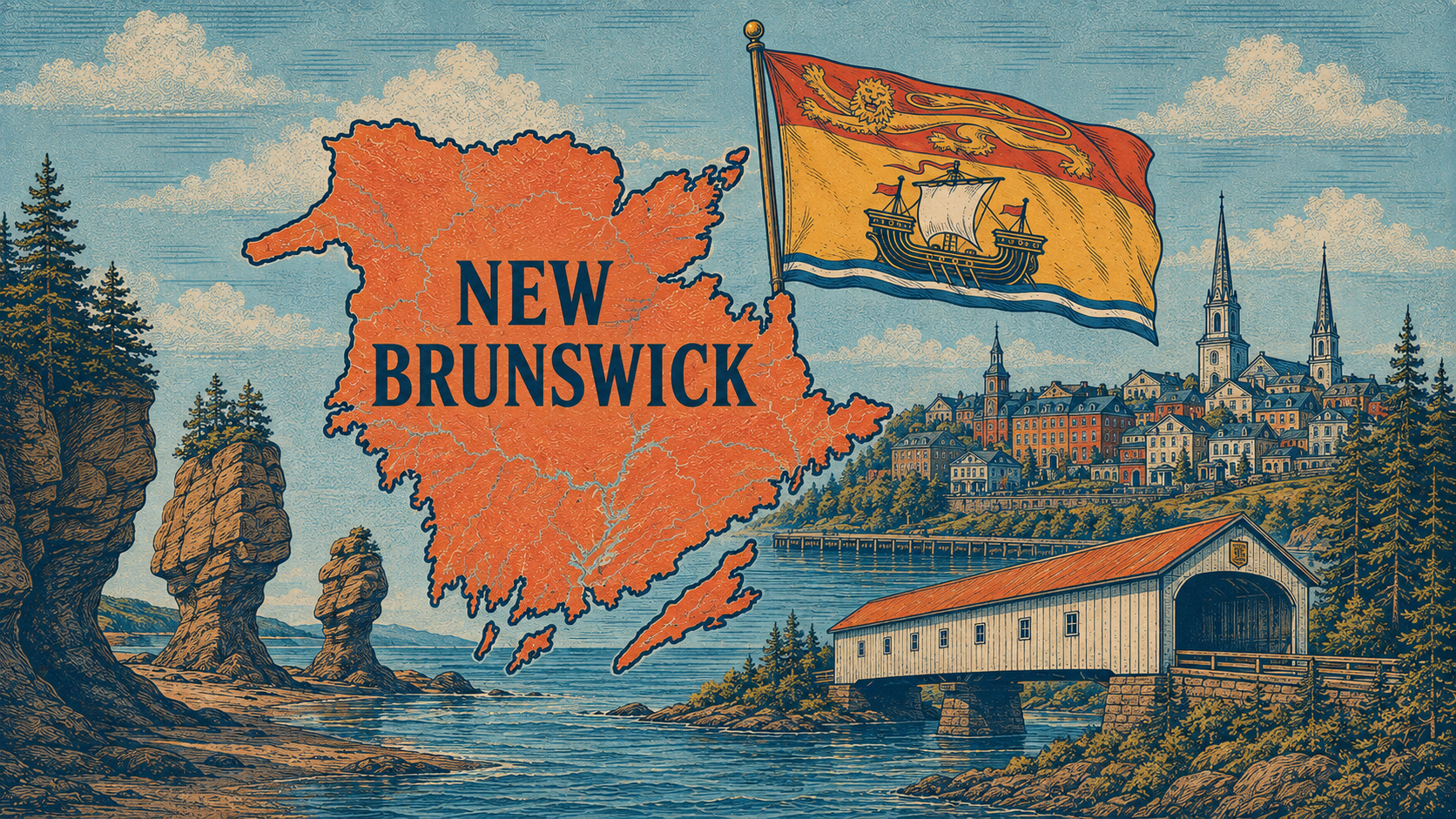
Whether your ancestors lived in Saint John, Fredericton, Moncton, Miramichi, Bathurst, Edmundston, or a small rural parish, New Brunswick offers an exceptional variety of genealogical records waiting to be explored.
At Trace, our professional genealogists specialize in New Brunswick genealogy research. We combine historical expertise with access to provincial, national, and international archives to uncover the people, places, and events that shaped your family's story.
Whether you're beginning your family tree, researching Acadian ancestry, tracing Loyalist or Irish roots, overcoming a research brick wall, or gathering evidence for Canadian citizenship by descent, Trace is ready to help.
New Brunswick's location along Canada's Atlantic coast made it a crossroads for settlement, trade, and migration. Its records document centuries of family history, from the earliest Acadian communities to nineteenth-century immigration and industrial development.
Professional New Brunswick genealogy research can help you discover:
Every record helps tell the story of your family's journey through generations.
When New Brunswick was created in 1784, it became Canada's first province established specifically to accommodate the arrival of United Empire Loyalists following the American Revolution. Thousands of Loyalist families settled throughout the province, leaving behind extensive land, military, and government records that remain invaluable to genealogists today.
New Brunswick genealogy combines multiple cultural traditions within one province. French Acadian settlements, Loyalist communities, Irish immigrants, Scottish settlers, and English colonists all created distinct records that often overlap geographically and historically.
Our genealogists regularly solve challenges involving:
Understanding these overlapping communities is essential for reconstructing New Brunswick family histories.
Following the Expulsion of the Acadians (Le Grand Dérangement) beginning in 1755, many Acadian families eventually returned to the Maritime Provinces. New Brunswick became one of the principal regions where Acadian communities were re-established, particularly along the northeastern coast and throughout the Madawaska region.
Today, New Brunswick remains home to one of the largest Acadian populations in the world. Parish registers, civil records, land grants, and local histories often allow researchers to reconnect families separated by the Expulsion and trace their origins back to the earliest settlements of Acadia and New France.
Trace's genealogists regularly help clients reconstruct Acadian family lines across New Brunswick, Nova Scotia, Prince Edward Island, Quebec, Louisiana, France, and beyond.
The conclusion of the American Revolution dramatically changed New Brunswick's history. Beginning in 1783, thousands of men and women who had remained loyal to the British Crown left the newly independent United States and resettled along the Saint John River and throughout the province.
These United Empire Loyalists established many of New Brunswick's earliest English-speaking communities and helped shape the province's political and economic development. Communities such as Saint John, Fredericton, Kingston, and Gagetown grew rapidly as Loyalist families received land grants and established farms, businesses, churches, and schools.
For genealogists, Loyalist ancestry offers outstanding research opportunities. Crown land grants, military service records, compensation claims, township papers, and Loyalist petitions often identify spouses, children, military service, previous residences in the American colonies, and extended family relationships. These records frequently bridge generations between colonial America and British North America.
Trace's professional genealogists regularly help families verify Loyalist ancestry and reconstruct migration paths spanning both Canada and the United States.
Irish immigration played a major role in shaping New Brunswick during the nineteenth century. While Irish families had settled in the province earlier, immigration increased dramatically during and after the Great Irish Famine (1845-1852).
Many Irish immigrants arrived through the port of Saint John, one of Atlantic Canada's busiest harbors. Some remained in Saint John and surrounding communities, while others established farms or worked in the province's lumber industry, shipbuilding, railways, and expanding towns.
Roman Catholic and Protestant church registers, passenger lists, land records, newspapers, cemetery records, and probate files often provide valuable clues for tracing Irish ancestors in New Brunswick. Many families later migrated to Ontario, the American Northeast, or Western Canada, creating rich cross-border research opportunities.
New Brunswick offers an outstanding collection of historical records for family historians.
Church records remain among the province's most valuable genealogical resources.
Our researchers regularly examine:
These records often include baptisms, marriages, burials, occupations, witnesses, and residences.
Land records frequently identify:
These collections are particularly valuable for Loyalist and early settlement research.
Probate files often document:
These records frequently resolve difficult genealogical questions.
Canadian census records provide detailed information regarding:
Our genealogists regularly research:
These collections often identify ancestral hometowns and migration routes.
Trace researches records relating to:
Military records frequently provide addresses, occupations, next of kin, and service histories.
For thousands of years, New Brunswick has been home to the Wolastoqiyik (Maliseet), Mi'kmaq, and Passamaquoddy (Peskotomuhkati) peoples. Their communities continue to play an essential role in the province's cultural and historical landscape.
Genealogical research involving Indigenous ancestry often relies on different sources than traditional immigrant genealogy. Depending on the family and historical period, records may include mission registers, treaty documents, church archives, government collections, community records, and oral histories. Some materials may only be available through Indigenous communities or may have restricted access.
Trace approaches Indigenous genealogy with respect for each community's history and an understanding of the unique research methods often required.
New Brunswick's history reflects centuries of migration and adaptation. French Acadians established some of the province's earliest European settlements before the Expulsion dramatically altered the region. Loyalists later transformed the political landscape following the American Revolution, while Irish and Scottish immigrants contributed to agriculture, forestry, shipbuilding, and commerce throughout the nineteenth century.
The province's extensive river systems and Atlantic coastline encouraged movement between communities, while close ties with Nova Scotia, Quebec, Prince Edward Island, and New England created generations of cross-border families. Understanding these migration patterns often leads researchers to records in multiple provinces and countries.
Our research process is designed to provide clarity, transparency, and dependable results.
We begin by reviewing your family history, existing documentation, and research goals.
Your genealogist develops a customized strategy targeting the historical records most likely to answer your questions.
Our team researches provincial archives, Library and Archives Canada, church repositories, land records, military collections, newspapers, probate files, and specialized historical archives.
Every discovery is carefully evaluated and supported by historical evidence.
You'll receive a professionally prepared report and calendar documenting every discovery, including source citations, record images when available, and recommendations for future research.
New Brunswick genealogy often involves multiple languages, religious traditions, and migration patterns spanning Canada, the United States, and Europe.
When you work with Trace, you benefit from:
Our goal is to preserve your family's history through carefully documented, professional research.
Our services are ideal for:
Whether your ancestors lived in Saint John, Fredericton, Moncton, Miramichi, Bathurst, Edmundston, or a small rural parish, Trace can help uncover their story.
You may also be interested in:
New Brunswick's story is one of resilience, migration, and community. From the Wolastoqiyik, Mi'kmaq, and Passamaquoddy peoples who have called this region home for thousands of years to Acadian settlers, United Empire Loyalists, Irish immigrants, Scottish pioneers, and generations of newcomers, every family has contributed to the province's remarkable history.
Whether your ancestors established Acadian communities, arrived as Loyalists after the American Revolution, immigrated from Ireland or Scotland, or built new lives along the Saint John River or the Bay of Fundy, Trace can help uncover the records that tell their story.
Our professional genealogists combine historical expertise with meticulous research methods to deliver discoveries that preserve your family's legacy for future generations.
Ready to discover your New Brunswick ancestors?
Whether you're tracing Acadian ancestry, researching Loyalist roots, documenting Irish or Scottish heritage, gathering evidence for Canadian citizenship by descent, researching Indigenous family connections, or breaking through a long-standing research brick wall, Trace is ready to help.
Request a consultation today and let Trace's professional genealogists uncover your New Brunswick family history.