
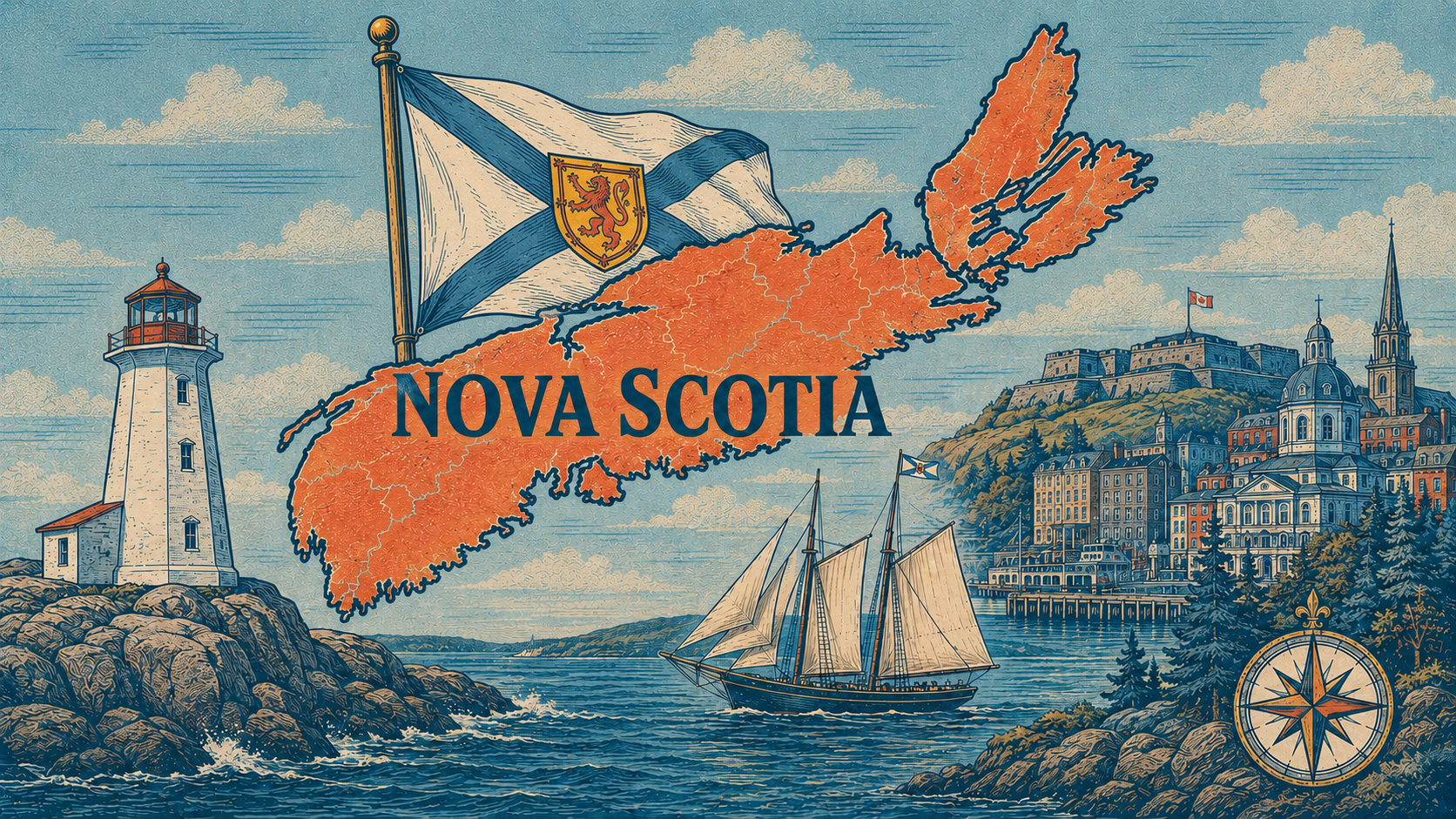
Nova Scotia is one of Canada's oldest European settlements and one of North America's richest genealogical regions. Long before European arrival, the land was home to the Mi'kmaq, whose communities have lived throughout Mi'kma'ki for thousands of years. Later, French settlers established Acadian communities, followed by British colonists, New England Planters, United Empire Loyalists, Black Loyalists, Scottish Highlanders, Irish immigrants, and families from around the world who helped shape the province's remarkable history.
Whether your ancestors lived in Halifax, Annapolis Royal, Lunenburg, Yarmouth, Sydney, Pictou, Antigonish, or a small coastal fishing village, Nova Scotia's extensive historical records preserve generations of family stories waiting to be discovered.
At Trace, our professional genealogists specialize in Nova Scotia genealogy research. We combine historical expertise with access to provincial, national, and international archives to uncover the people, places, and events that shaped your family's history.
Whether you're beginning your family tree, researching Acadian ancestry, tracing Scottish or Irish roots, overcoming a research brick wall, or gathering evidence for Canadian citizenship by descent, Trace is ready to help.
Nova Scotia's history is unlike any other province in Canada. Its location on the Atlantic coast made it a gateway for explorers, settlers, immigrants, soldiers, merchants, and fishermen for more than four centuries.
Professional Nova Scotia genealogy research can help you discover:
Every historical record helps transform family stories into documented history.
Between 1928 and 1971, nearly one million immigrants entered Canada through Pier 21 in Halifax. Often called Canada's Ellis Island, Pier 21 served as the country's primary immigration gateway for much of the twentieth century and remains one of the country's most important resources for researching recent immigrant ancestors.
Nova Scotia's genealogy reflects centuries of cultural diversity and historical change. French settlers established Acadian communities during the seventeenth century before British rule transformed the province. Later migrations brought New England Planters, United Empire Loyalists, Black Loyalists, Scottish Highlanders, Irish immigrants, German settlers, and many others.
Our genealogists regularly solve challenges involving:
Understanding these historical migrations is essential for accurately reconstructing Nova Scotia family histories.
One of the defining stories of Nova Scotia is the history of the Acadians, descendants of French settlers who established thriving farming communities throughout the province beginning in the early seventeenth century.
In 1755, during the French and Indian War, British authorities began the Expulsion of the Acadians, known in French as Le Grand Dérangement. Thousands of Acadian families were forcibly removed from their homes and dispersed throughout the British colonies, Britain, France, and the Caribbean. Many eventually settled in present-day New Brunswick, Prince Edward Island, Quebec, and Louisiana, where their descendants became known as Cajuns.
For genealogists, Acadian research is both fascinating and challenging. Families often moved several times over multiple generations, and records may be found across several countries and jurisdictions. Church registers, French colonial records, land grants, military documents, and parish records all contribute to reconstructing Acadian family histories.
Trace's genealogists regularly help clients reconnect Acadian families separated by the Expulsion, tracing lineages across Canada, the United States, and Europe through carefully documented historical research.
Irish immigrants have played a significant role in Nova Scotia's history for more than two centuries. While some Irish settlers arrived during the eighteenth century, the largest wave of immigration occurred during the nineteenth century, particularly during and after the Great Irish Famine (1845-1852). Thousands of Irish families crossed the Atlantic seeking safety, employment, and the opportunity to build new lives in British North America.
Many immigrants first arrived in Halifax, one of the busiest ports in Atlantic Canada. From there, some settled in the city itself, while others established farming communities or found work in industries such as shipbuilding, fishing, mining, and lumber throughout the province. Significant Irish communities developed in Halifax, Antigonish, Cape Breton, Pictou County, Guysborough County, and along Nova Scotia's eastern shore.
Irish genealogy in Nova Scotia often begins with Roman Catholic and Protestant church registers, which recorded baptisms, marriages, and burials long before comprehensive civil registration. Passenger lists, land grants, census records, probate files, newspapers, and cemetery records can provide additional insight into where families settled and how communities developed. Many Irish families also maintained close connections with relatives who later settled elsewhere in Canada or immigrated to the United States, creating valuable cross-border research opportunities.
For descendants of Irish immigrants, Nova Scotia frequently served as the first documented stop in North America before later generations moved westward into Ontario, the Canadian Prairies, or south into New England. Trace's professional genealogists specialize in connecting these records, helping families identify ancestral parishes in Ireland, reconstruct migration routes, and document generations of Irish heritage on both sides of the Atlantic.
Nova Scotia, particularly Cape Breton Island, became one of the most important destinations for Scottish Highland immigrants outside Scotland. Beginning in the late eighteenth century and continuing throughout the nineteenth century, thousands of Scots left the Highlands following events such as the Highland Clearances, seeking farmland, economic opportunity, and greater stability.
Many Scottish settlers established communities in Cape Breton, Pictou County, Antigonish County, and Inverness County, where Gaelic language and traditions continued for generations. Churches, schools, and cultural societies helped preserve Scottish heritage, and many communities retain strong Highland identities today.
Researching Scottish ancestors often involves connecting Nova Scotia church records, land grants, census records, probate files, and cemetery records with parish registers and civil records in Scotland. Trace's genealogists regularly help families identify their ancestral Highland communities and trace generations on both sides of the Atlantic.
Nova Scotia offers one of Canada's richest collections of historical records. Trace researchers regularly work with the following resources.
Church records form the foundation of Nova Scotia genealogy.
Our researchers regularly examine:
These records frequently document baptisms, marriages, burials, family relationships, occupations, and residences.
Nova Scotia land records often identify:
These records are particularly valuable for Loyalist, Scottish, Irish, and early settlement research.
Nova Scotia probate records can reveal:
They frequently solve difficult genealogical questions involving multiple generations.
Canadian census records document Nova Scotia families through successive generations and often include:
Nova Scotia's maritime location produced extensive immigration documentation.
Our genealogists regularly research:
These collections often identify ancestral hometowns and migration paths.
Military service has shaped Nova Scotia's history for centuries.
Trace researches records relating to:
These files often contain valuable genealogical details, including next of kin, residences, occupations, and service histories.
Nova Scotia is home to one of the most significant Black Loyalist histories in North America. Following the American Revolution, approximately 3,500 Black Loyalists arrived in Nova Scotia after supporting the British during the war. Many settled in communities including Birchtown, Shelburne, Preston, Hammonds Plains, and Brindley Town.
Despite facing discrimination and hardship, Black Loyalists established churches, schools, businesses, and communities that remain an important part of Nova Scotia's heritage. Their descendants contributed significantly to the cultural and social history of Atlantic Canada.
Genealogical research may include military records, the Book of Negroes, land petitions, church registers, census records, and community histories. Trace's genealogists help clients connect these historical sources to reconstruct Black Loyalist family histories and identify earlier origins in the American colonies and beyond.
For thousands of years before European settlement, Nova Scotia formed part of Mi'kma'ki, the traditional homeland of the Mi'kmaq people. The Mi'kmaq developed vibrant communities throughout the region, maintaining extensive trade networks, governance systems, and cultural traditions that continue today.
Genealogical research involving Mi'kmaq ancestry often relies on different sources than traditional immigrant genealogy. Depending on the family and historical period, research may involve mission records, church registers, treaty documents, government records, community archives, oral histories, and other specialized collections. Access to some records may be governed by community protocols or archival restrictions.
Trace approaches Indigenous genealogy with respect for Mi'kmaq history and an understanding of the unique research methods required for documenting Indigenous family histories.
Nova Scotia's history is one of continuous migration and cultural exchange. French settlers established Acadian communities in the early 1600s, creating prosperous farming settlements throughout the Annapolis Valley and along the Bay of Fundy. Following British control of the region, New England Planters, United Empire Loyalists, Black Loyalists, Scottish Highlanders, Irish immigrants, and German Protestants established new communities across the province.
Its location on the Atlantic Ocean also made Nova Scotia one of Canada's most important maritime provinces. Fishing, shipbuilding, trade, and military service shaped generations of families whose lives are documented in parish registers, shipping records, newspapers, land grants, and probate files.
These diverse settlement patterns make Nova Scotia one of Canada's most rewarding provinces for genealogical research.
Our research process is designed to provide clarity, transparency, and dependable results.
We begin by reviewing your family history, existing documents, photographs, and research goals to determine the best starting point.
Your genealogist develops a customized research strategy targeting the record collections most likely to answer your questions.
Our team conducts detailed research using provincial archives, Library and Archives Canada, church repositories, land records, military files, historical newspapers, immigration records, and specialized historical collections.
Every discovery is carefully analyzed and supported by historical evidence.
You'll receive a professionally prepared report documenting every discovery, complete with source citations, historical context, record images when available, and recommendations for future research.
Nova Scotia genealogy often spans multiple cultures, languages, and countries. Successfully reconstructing a family history requires experience with Acadian records, Scottish and Irish immigration, Loyalist documentation, maritime history, and church archives.
When you work with Trace, you benefit from:
Our goal is to produce research that is accurate, well documented, and meaningful for you and future generations.
Our services are ideal for:
Whether your ancestors lived in Halifax, Sydney, Lunenburg, Yarmouth, Antigonish, Pictou, Shelburne, or a small coastal village, Trace can help uncover their story.
Nova Scotia's history is unlike any other in Canada. From the Mi'kmaq people whose connection to the land stretches back thousands of years to Acadian pioneers, Scottish Highland settlers, Irish immigrants, United Empire Loyalists, Black Loyalists, and generations of newcomers who arrived by sea, each community has contributed to the province's remarkable heritage.
Whether your ancestors farmed the Annapolis Valley, fished the Atlantic coast, settled in Cape Breton, built new lives in Halifax, or later migrated throughout Canada and the United States, Trace can help uncover the records that tell their story.
Our professional genealogists combine historical expertise with meticulous research methods to deliver discoveries that preserve your family's legacy for future generations.
Ready to discover your Nova Scotia ancestors?
Whether you're tracing Acadian roots, Scottish Highland heritage, Irish immigrant ancestors, Black Loyalist families, documenting ancestry for Canadian citizenship by descent, researching Mi'kmaq family connections, or breaking through a long-standing research brick wall, Trace is ready to help.
Schedule a consultation today and let Trace's professional genealogists uncover your Nova Scotia family history.
Trace’s expertise extends far beyond Nova Scotia, encompassing professional genealogy research across Canada. Our genealogists assist clients with family history projects in Alberta, British Columbia, Manitoba, New Brunswick, Newfoundland and Labrador, Ontario, Prince Edward Island, Quebec, Saskatchewan, and throughout Canada’s provinces and territories.
Canadian family history research often requires navigating records held by multiple jurisdictions, archives, churches, and local repositories. Trace develops a focused research strategy for each project, connecting evidence from civil registrations, census returns, land files, probate records, newspapers, military collections, immigration documents, and other historical sources. The result is a carefully documented account of your family’s Canadian roots, supported by reliable evidence and meaningful historical context.