
Few states offer a richer or more diverse genealogical record than Pennsylvania. From William Penn’s Quaker experiment to the bustling industrial centers of the nineteenth century, Pennsylvania’s history reflects waves of settlement, innovation, and immigration that helped define America. Families who lived, worshiped, and worked here left behind a wealth of records documenting lives shaped by freedom, opportunity, and transformation.
Tracing Pennsylvania ancestry connects you with one of the nation’s most enduring historical traditions. With Trace, you gain expert partners who understand the complexity of the state’s archives and can reveal the stories behind centuries of change, from early colonial townships to coal country and city neighborhoods.
.png)
Pennsylvania’s story began in 1681 when King Charles II granted a charter to William Penn, creating a colony founded on principles of religious freedom and tolerance. Penn invited settlers from across Europe, and his “holy experiment” quickly attracted Quakers, Germans, Scots-Irish, Dutch, and other groups seeking liberty and land. Early records from this period include land grants, church registers, and legal proceedings that capture the colony’s cultural diversity and pioneering spirit.
By the mid-eighteenth century, Pennsylvania had become a vital crossroads of trade and migration. Philadelphia grew into one of the largest cities in the colonies, serving as both a political center and a hub for immigrants arriving from the British Isles and continental Europe. Inland, German-speaking communities established prosperous farms in Lancaster, Berks, and York Counties, leaving behind detailed church and tax records that remain central to family research.
During the Revolutionary era, Pennsylvania played a defining role in shaping American independence. The Continental Congress met in Philadelphia, and soldiers from across the state fought in the struggle for liberty. Military rosters, supply records, and local committee minutes from this time preserve vivid traces of ordinary citizens participating in extraordinary events.
In the early nineteenth century, the state’s canals, ironworks, and railroads fueled economic growth and drew new waves of migration. Irish laborers, Welsh miners, and later Italian, Polish, and Eastern European families arrived to work in coal, steel, and manufacturing industries. These communities left parish records, naturalization files, and employment documentation that provide a detailed portrait of working-class life.
By the twentieth century, Pennsylvania stood at the heart of American industrial and cultural life. Urban growth in Pittsburgh, Philadelphia, Scranton, and Erie, along with rural depopulation and westward migration, reshaped family lines. The state’s continued emphasis on civic recordkeeping through county courthouses, vital statistics offices, and historical societies ensures that generations of Pennsylvanians remain traceable across centuries.
Pennsylvania counties began keeping vital records in the late 1800s, with earlier records found at the township and church level. Trace genealogists draw on both civil and ecclesiastical sources to build comprehensive family timelines that bridge the colonial, statehood, and industrial periods.
Religious records form the foundation of early Pennsylvania genealogy. Lutheran, Reformed, Mennonite, Quaker, and Catholic congregations all maintained baptismal, marriage, and burial registers. Quaker meeting minutes, in particular, provide rich narrative accounts that detail family movements, community disputes, and migration out of Pennsylvania into Ohio, Indiana, and beyond.
Land ownership has been a constant thread in Pennsylvania’s history. Early warrants and surveys, often signed by William Penn’s proprietary agents, document the earliest settlers. Later deeds and wills reveal inheritance patterns and social connections that persisted for generations. Trace researchers interpret these complex land divisions to link modern families with their colonial roots.
Pennsylvanians served in every major conflict from the colonial Indian wars through both World Wars. Muster rolls, draft registrations, and veterans’ pension applications document service across three centuries. These records often reveal personal details such as ages, occupations, and family members that enrich genealogical narratives.
As one of the principal ports of entry to North America, Pennsylvania received tens of thousands of immigrants through Philadelphia. Ship manifests, naturalization petitions, and alien registration files record arrivals from Ireland, Germany, and later Southern and Eastern Europe. Trace genealogists use these materials to connect ancestral origins abroad with the lives families built in America.
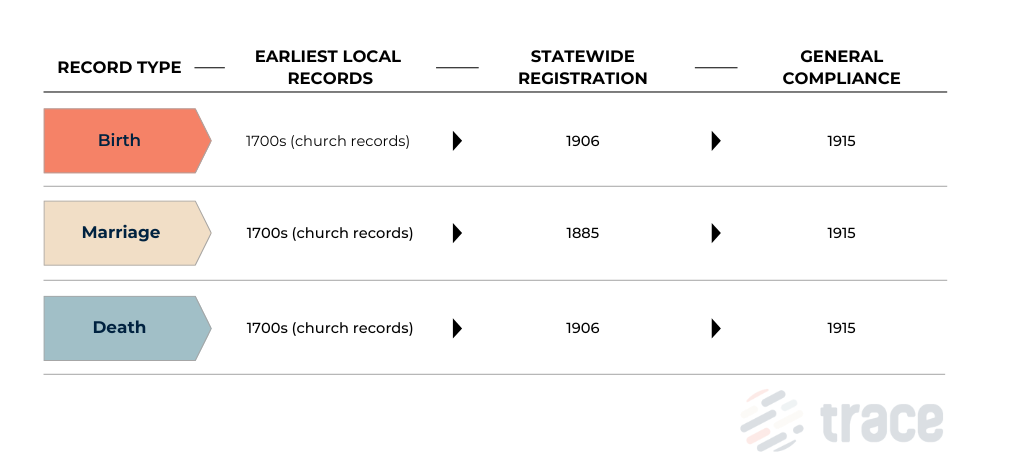
Pennsylvania’s vital and church-based records form a continuous record of family life from the eighteenth century onward. Trace genealogists combine these with court, census, and immigration sources to build accurate, multi-generational research results.
Pennsylvania’s diversity and longevity have produced a broad archival legacy that touches nearly every aspect of family and community life.
Trace genealogists bring these materials together to illuminate Pennsylvania’s dynamic past and the families who helped shape it.
Pennsylvania’s history is marked by cultural diversity, religious tolerance, and steady recordkeeping. Each tradition, whether Quaker, German, Scots-Irish, or immigrant, left unique documentation that requires specialized knowledge to interpret. Trace genealogists are experienced in analyzing these varied records, recognizing regional differences, and connecting ancestral stories across centuries of Pennsylvania life.
Trace researchers combine historical expertise with a deep understanding of Pennsylvania’s evolving archival landscape. Whether you are uncovering colonial Quaker ancestors, tracing immigrant arrivals through Philadelphia, or linking generations of steelworkers and farmers, Trace transforms historical evidence into a clear, well-documented family story.
Pennsylvania’s archives capture the growth of a state and a nation built on diversity, determination, and opportunity. Working with Trace ensures that your family’s story within that history is uncovered with accuracy, insight, and care.
Start your Pennsylvania genealogy research with Trace today!