
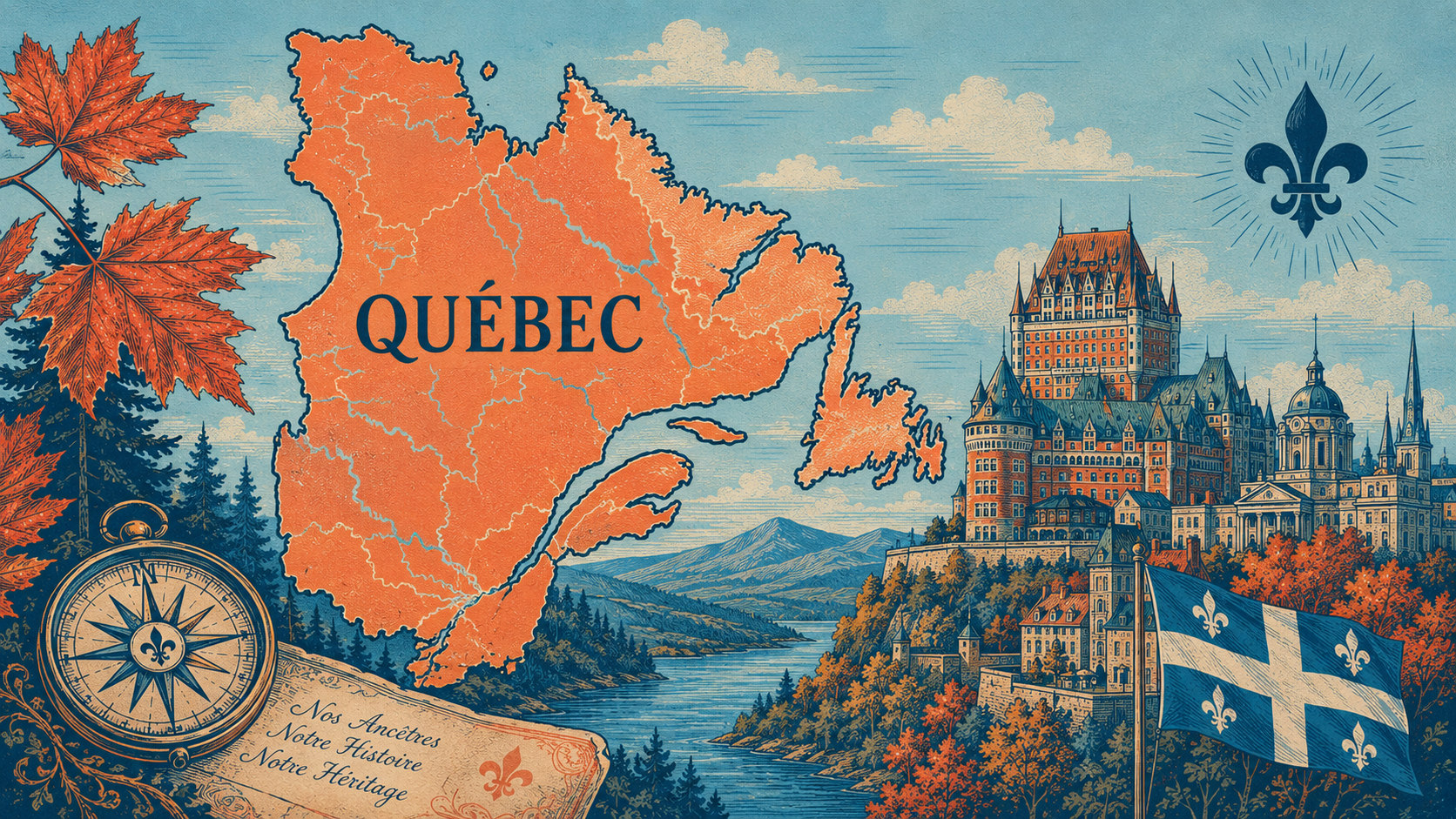
Quebec is home to one of the richest genealogical traditions in North America. Its history has been shaped by First Nations, Inuit, and Métis communities, the arrival of French settlers in New France, Acadian families, British rule, and later waves of immigrants from around the world. Thanks to centuries of carefully preserved parish registers, civil records, and notarial archives, many Quebec family lines can be traced back to the earliest European settlers in Canada.
Whether your ancestors lived in Québec City, Montréal, Trois-Rivières, Saguenay, the Eastern Townships, or a small parish along the St. Lawrence River, Quebec's historical records provide remarkable opportunities for discovering your family's story.
At Trace, our professional genealogists specialize in Quebec genealogy research. We combine historical expertise with access to archives throughout Canada and internationally to uncover the people, places, and events that shaped your family's history.
Whether you're documenting your French Canadian ancestry, researching Acadian roots, reconnecting with your heritage, overcoming a research brick wall, or gathering evidence to support Canadian citizenship by descent, Trace is ready to help.
Few places offer genealogists the depth of documentation found in Quebec. The province's exceptional historical records allow many families to trace their ancestry continuously for more than three centuries.
Professional Quebec genealogy research can help you discover:
Each discovery adds another chapter to your family's remarkable story.
Unlike many regions of North America, Quebec's Roman Catholic Church maintained exceptionally detailed parish registers beginning in the seventeenth century. These records often include parents, grandparents, witnesses, occupations, and residences, allowing researchers to reconstruct families with extraordinary accuracy.
Many French Canadian families can trace their ancestry to the earliest settlers of New France because these records have survived for centuries.
Researching Quebec ancestors requires specialized knowledge that extends well beyond reading historical records. Most early documents were written in French, historical handwriting can be difficult to interpret, and many families adopted unique naming customs that differ from those found elsewhere in North America.
Our genealogists regularly solve challenges involving:
Understanding Quebec's unique historical, linguistic, and cultural traditions is essential to accurately reconstructing family histories.
One of the most distinctive aspects of French Canadian genealogy is the use of dit names. The French word dit means "called," and these alternate surnames became common among settlers in New France during the seventeenth and eighteenth centuries.
A soldier, craftsman, or settler might adopt a secondary surname to distinguish himself from others with the same family name, identify his place of origin, commemorate military service, or describe a personal characteristic. For example, an ancestor recorded as Pierre Gagnon dit Bellavance might appear in historical records as Pierre Gagnon, Pierre Bellavance, or Pierre Gagnon Bellavance. Over time, some descendants continued using the original surname, while others adopted only the dit name, creating entirely separate family branches that descended from the same ancestor.
Understanding this naming tradition is essential for successful Quebec genealogy research. Many family historians mistakenly believe an ancestor disappeared from the historical record, when in reality the family simply began using a different surname. Trace's professional genealogists are experienced in identifying dit names and tracing families across multiple surname variations, ensuring that important records are not overlooked.
Quebec offers some of the most comprehensive genealogical resources in North America. Trace researchers regularly work with the following record collections.
Parish registers are the cornerstone of Quebec genealogy.
These records often include:
Many French Canadian families can be documented continuously for centuries using parish records.
The Drouin Collection is one of the most valuable resources for Quebec genealogy. It contains millions of parish register images from Quebec, Ontario, Acadia, and parts of the northeastern United States.
Our genealogists use this collection alongside original parish registers to verify family relationships and extend ancestral lines.
PRDH is one of the world's premier databases for early French Canadian genealogy. It links thousands of historical records from New France, helping researchers reconstruct families and communities during the colony's earliest years.
Professional genealogists use PRDH together with original records to build well-documented family histories.
BMS2000 is an important collaborative database indexing baptisms, marriages, and burials from many Quebec parishes.
When combined with parish registers and civil records, it provides another valuable tool for locating French Canadian ancestors.
Civil registration complements church records for more recent generations. Birth, marriage, and death registrations provide additional documentation and help connect twentieth-century families with earlier parish records.
Quebec's notarial archives are among the richest genealogical collections in North America.
These documents may include:
Notarial records often preserve details unavailable in any other historical source.
Before the Seigneurial system was abolished in 1854, much of Quebec's land was distributed through seigneuries.
These records can reveal:
Canadian census records document families across generations and often include birthplace, occupation, religion, language, immigration status, and family relationships.
Military service files provide valuable insights into ancestors who served during:
Many French Canadian families descend from a relatively small number of settlers who established New France during the seventeenth and eighteenth centuries.
Trace regularly researches descendants of:
By combining parish registers, notarial records, census records, and historical archives, our genealogists can often reconstruct family lines spanning ten or more generations.
Long before the arrival of European settlers, Quebec was home to diverse Indigenous peoples whose histories continue to shape the province today. These include the Abenaki, Algonquin (Anishinaabe), Atikamekw, Cree (Eeyou), Huron-Wendat, Innu, Mi'kmaq, Mohawk (Kanien'kehá:ka), Naskapi, and Inuit communities of Nunavik, along with historic and contemporary Métis communities.
Genealogical research involving Indigenous ancestry often relies on different sources than traditional immigrant research. Depending on the family and time period, records may include mission registers, treaty records, government records, church archives, community collections, oral histories, and other historical documentation. Trace approaches Indigenous genealogy with care, respect, and an understanding of the unique historical context surrounding these records.
Between the mid-nineteenth and early twentieth centuries, hundreds of thousands of French Canadians left Quebec to seek employment in the textile mills, factories, and industrial centers of New England.
Today, millions of Americans have French Canadian ancestry, often without realizing how recently their ancestors crossed the border.
Trace regularly helps clients connect American records with Quebec parish registers for families who settled in:
These cross-border connections frequently open entirely new branches of a family tree.
Our research process is designed to provide clarity, transparency, and dependable results.
Every project begins with a conversation about your goals, family history, and existing documentation.
Your genealogist develops a customized strategy targeting the historical records most likely to answer your questions.
Our team researches parish registers, civil records, notarial archives, census records, land documents, military files, immigration records, and specialized historical collections throughout Quebec and beyond.
Every discovery is carefully analyzed and supported by historical evidence.
You'll receive a professionally prepared report documenting every discovery, complete with source citations, record images when available, historical context, and recommendations for future research.
Quebec genealogy is unlike research anywhere else in North America. Success requires expertise in French-language records, historical naming customs, religious records, and centuries of interconnected family lines.
When you work with Trace, you benefit from:
We believe every Quebec family deserves a carefully documented history built upon reliable research.
Our services are ideal for:
Whether your ancestors lived in Québec City, Montréal, Trois-Rivières, Sherbrooke, Saguenay, Rimouski, or a small parish along the St. Lawrence River, Trace can help uncover their story.
You may also be interested in:
Quebec possesses some of the finest genealogical records in the world, but unlocking their full potential requires historical knowledge, careful analysis, and experience navigating centuries of French-language documentation.
Whether your ancestors were among the earliest settlers of New France, members of Acadian communities, descendants of First Nations, Inuit, or Métis families, French Canadians who later migrated to New England, or more recent arrivals who made Quebec their home, Trace can help uncover the records that tell their story.
Our professional genealogists combine expertise in French Canadian history with meticulous research methods to deliver discoveries that preserve your family's legacy for future generations.
Ready to discover your Quebec ancestors?
Whether you're tracing a French Canadian surname, researching Acadian heritage, uncovering a family's original dit name, documenting ancestry for Canadian citizenship by descent, researching Indigenous family connections, or connecting your New England family back to Quebec, Trace is ready to help.
Request a consultation today and let Trace's professional genealogists uncover your Quebec family history.
Trace’s expertise extends beyond Quebec to genealogy research throughout Canada. Our professional genealogists assist clients with family history projects involving Alberta, British Columbia, Manitoba, New Brunswick, Newfoundland and Labrador, Nova Scotia, Ontario, Prince Edward Island, Saskatchewan, and other Canadian provinces and territories. Whether your ancestors were early settlers, immigrants, farmers, miners, fishermen, railway workers, homesteaders, or members of families who migrated between provinces or across the United States border, Trace can locate and analyze the records needed to uncover their stories and document their place in Canadian history.